Presenting at the Magento Association Townhall
I'm honoured to be presenting at the Magento Association Townhall Q1-2 2026, where I'll be sharing the developer documentation infrastructure I've been building for the Magento open source community.
This is a project I've poured significant time into — not as paid client work, but as a genuine contribution to the ecosystem that has given me my career.
The Problem
Magento's official developer documentation has been a long-standing pain point for the community. Since Adobe shifted focus, critical gaps have emerged — outdated guides, missing module references, and no structured path for developers to learn the platform properly. The Magento Association identified this as a priority, and I stepped up to build the infrastructure to fix it.
What I Built
The solution is a three-project pipeline, each handling a distinct stage of the documentation lifecycle:
1. the-core — Source Code Parser
A Node.js tool that introspects the entire Magento 2 codebase. It parses every di.xml, events.xml, and module.xml across all 344 core modules, extracting plugins, observers, dependencies, and service contracts into structured data. This is the foundation — you can't document what you haven't mapped.
2. developer-mastra — AI Generation Engine
A TypeScript RAG pipeline built with LangChain that generates documentation from the parsed data. It pulls context from five sources — a Qdrant vector store, local documentation, Magento source code, module dependency graphs, and external Magento docs via Context7 MCP. Every document passes through a three-agent review loop (Reviewer, Qualifier, Updater) that iterates until reaching a 9.5/10 quality threshold.
3. html-docs-transformer — HTML Builder
Converts the generated Markdown into production-ready HTML with seven semantic transformations: callout boxes, numbered step cards, breadcrumb navigation, auto-generated table of contents, syntax-highlighted code blocks, enhanced lists, and section cards. Built on Magento's orange/charcoal design system with WCAG AA accessibility.
The Numbers
- 344 core modules in scope
- 9 documentation types per module (README, Architecture, Execution Flows, Plugins & Observers, Integrations, Anti-Patterns, Known Issues, Version Compatibility, Performance)
- 3,096 total documents planned
- 10 priority modules already documented (Catalog, Sales, Customer, Checkout, Quote, Payment, Shipping, Store, EAV, ConfigurableProduct)
- 90 module reference documents generated
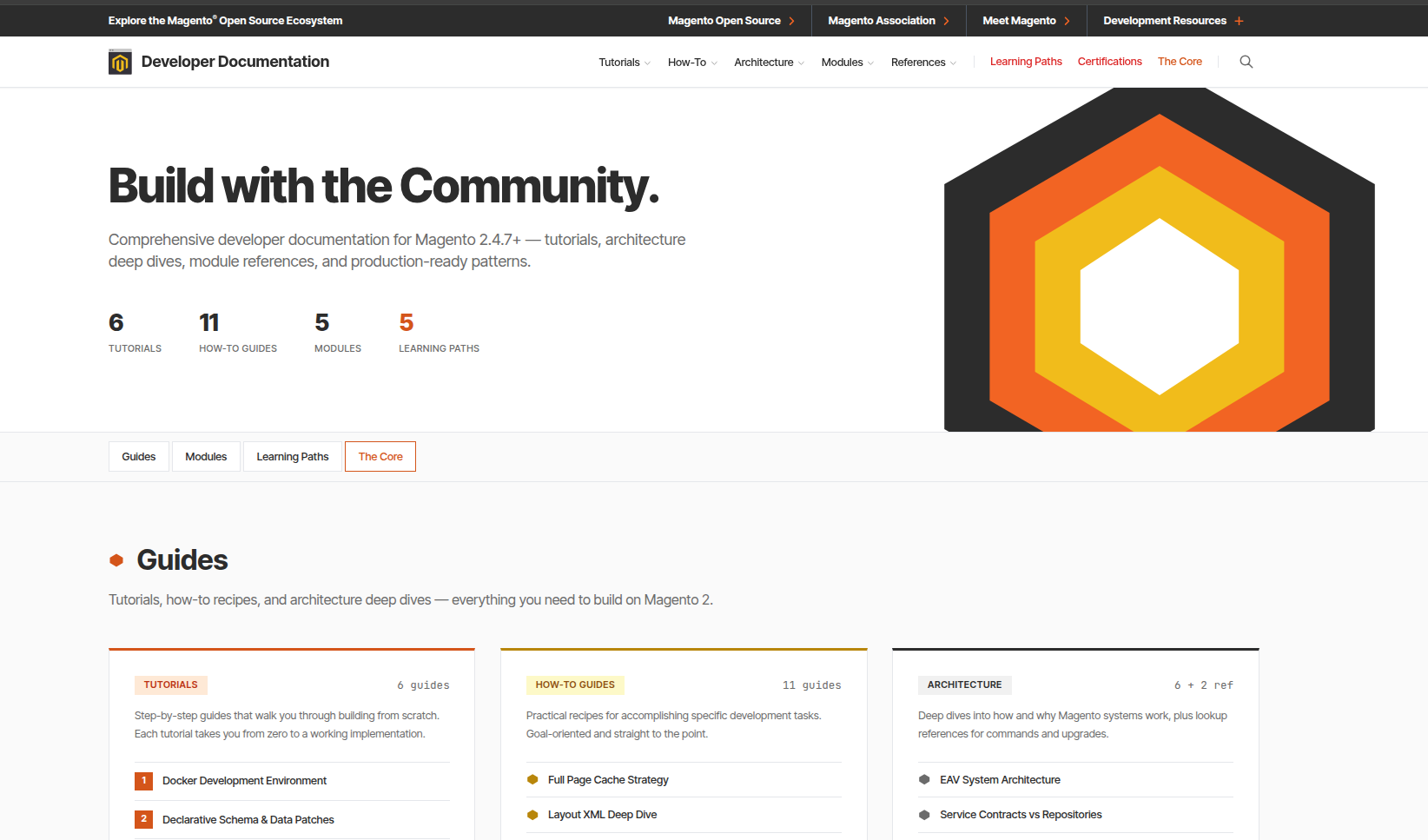
- 6 tutorials, 11 how-to guides, and 5 structured learning paths published
- 160+ total documents live today
The Tech Stack
- TypeScript throughout
- LangChain for AI orchestration
- Qdrant for vector search and semantic retrieval
- Handlebars for consistent document templating
- Tailwind CSS and Alpine.js for the documentation site
- No build process required — CDN-delivered, zero-config
The Documentation Site
The published site follows the Divio documentation framework — every document is classified as a Tutorial (learning-oriented), How-To (task-oriented), Explanation (conceptual), or Reference (lookup). Five learning paths guide developers from beginner through to enterprise-level architecture.
You can explore the live documentation at carlsimpson.co.uk/magento-association/
What I'll Cover at the Townhall
The presentation walks through the full pipeline — from source code parsing to published HTML — with live examples of generated documentation. I'll demonstrate the three-agent review system, show how the five-source RAG retrieval produces accurate technical content, and outline the 13-phase roadmap to reach 90 priority modules.
Why This Matters
Good documentation is what separates a thriving open source project from one that slowly loses contributors. Magento has incredible depth, but without proper documentation, that depth becomes a barrier rather than a strength. This infrastructure makes it possible to systematically document the entire platform — and keep it up to date as the codebase evolves.
Get Involved
The Magento Association is building something important here, and the documentation initiative needs community input. If you work with Magento daily, your expertise on specific modules, anti-patterns, and integration gotchas is exactly what makes these docs valuable. Review what's been generated, share feedback, and help prioritise which modules come next.
You can view the full presentation deck at carlsimpson.co.uk/magento-association/TOWNHALL-PRESENTATION.html and explore the live documentation at carlsimpson.co.uk/magento-association/